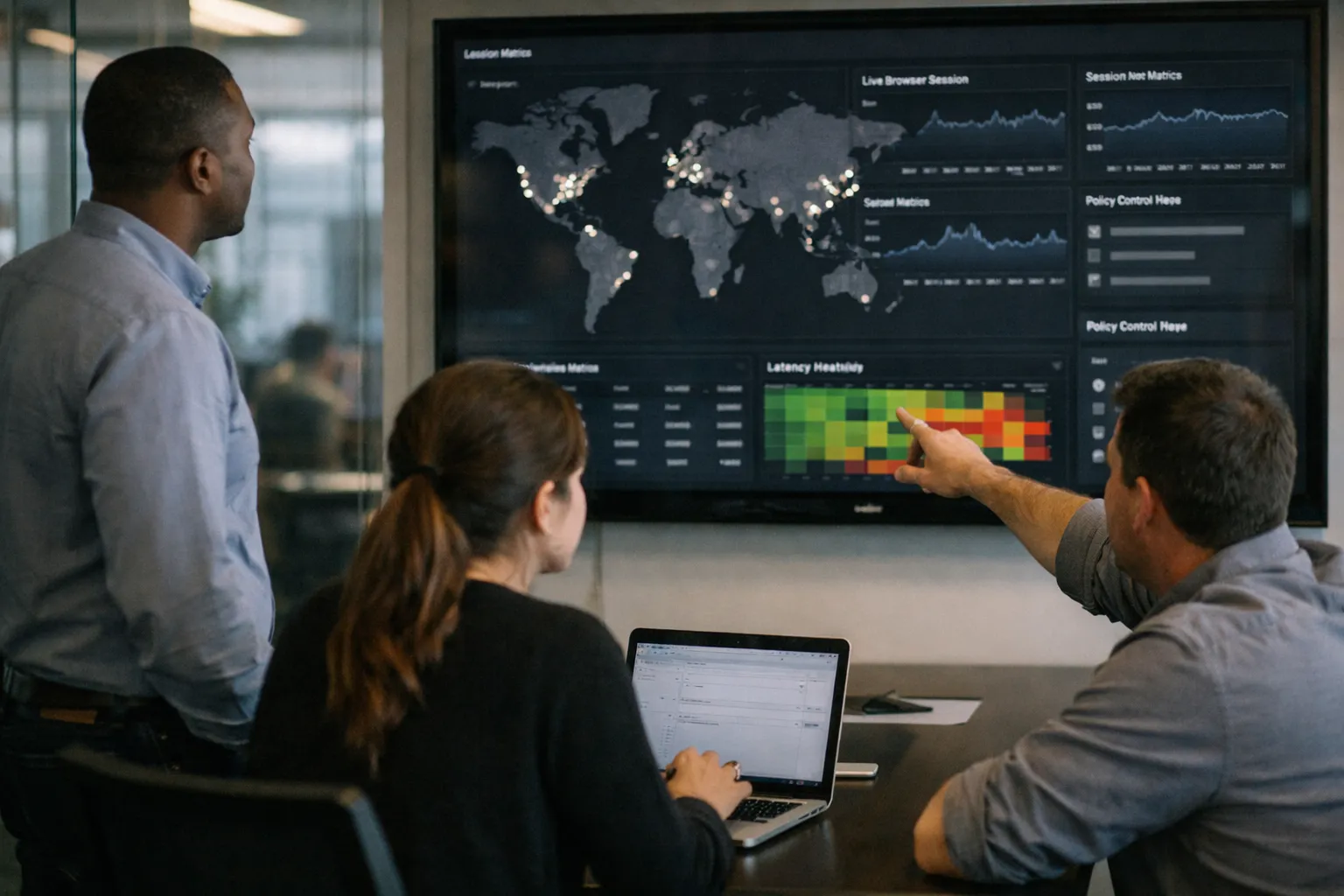
Overview — What we’re analyzing and why it matters
Enterprises revisiting their browser strategy in November 2026 face a market materially evolved since mid‑2026. Remote/Cloud-hosted browser isolation (RBI) has continued to mature into a mainstream control, while client-managed browsers have deepened integrations with endpoint security, identity and Zero Trust frameworks. This update synthesizes late‑2026 developments—vendor consolidation, wider edge deployment, improved session fidelity, evolving telemetry standards and new commercial models—and gives security, procurement and IT teams concrete steps to design resilient hybrid deployments now.
Background — what changed since June 2026
Three practical shifts have driven decision-making through 2026:
- Consolidation and product integration. Larger SASE/SSE and cloud CDN vendors accelerated acquisitions or deeper partnerships with RBI specialists. The result is tighter wiring between isolation nodes, identity decision engines and SSE policy orchestration—reducing integration friction but raising vendor‑selection tradeoffs.
- Edge densification and hardware encoding. Providers expanded metro‑level points of presence (PoPs) and introduced GPU‑accelerated encoding at edge sites. That widened the set of acceptable low‑latency use cases for isolation—especially for audio/video collaboration and many interactive SaaS apps—when users are within a regional PoP footprint.
- Operationalized telemetry and forensics. Enterprises moved toward a hybrid observability model that links endpoint telemetry (EDR, process/file events) to structured session artifacts from isolation services (DOM change logs, HTTP request traces, signed replay packages). Emerging best practices emphasize timestamp and identity linkage, protected artifact storage, and playbooks that map session artifacts to EDR alerts for rapid triage.
Data & evidence — what’s observable in Nov 2026
- Deployment patterns persisted but matured. The four patterns from mid‑2026 remain dominant: pure client-managed, full RBI, split‑horizon hybrid, and adaptive isolation. However, more large organizations (>5,000 seats) now operate explicit policy tiers that automatically route up to 40–60% of generic web traffic into isolation during work hours.
- Latency gap narrowed, not closed. Edge GPU encoding and session pinning made RBI acceptable for the majority of knowledge-workflows when round‑trip times (RTT) to the PoP remain under ~50 ms. High‑frequency trading, certain interactive 3D editing, and local debugging remain better served by client browsers.
- Functional parity improved on key features. By late‑2026 most production RBI offerings reliably support WebRTC relays, WebAuthn via virtual authenticator bridges, selective USB/serial passthrough, and controlled extension emulation. Differences persist in complex SSO flows, custom helper apps and full native code signing flows—areas requiring pilot validation.
- Commercial models diversified. Vendors moved beyond simple per‑minute pricing. Popular constructs now include per‑concurrent‑session bundles, blended compute+egress caps, and predictable "workload buckets" (e.g., research sessions vs. AV sessions) priced separately to reduce billing surprises.
- Regulatory focus on ephemeral artifacts rose. Auditors and internal legal teams increasingly require proof of processing locations and retention for transient session artifacts (DOM snapshots, recorded replays). Contractual appendices and processing‑location SLAs are now standard negotiation items for regulated industries.
Multiple perspectives — vendors, security teams and users
Vendors: Many RBI vendors now position their products inside SSE suites or as tightly integrated edge services from cloud CDN providers. Their messaging emphasizes regional SLAs, codec acceleration and telemetry exports designed for SIEM/SOAR ingestion.
Security teams: CISOs in finance, insurance and healthcare report meaningful reductions in web‑borne incidents when RBI is applied to unknown vendors and contractor access. Security engineering teams, however, still allocate dedicated compatibility cycles for developer and design teams where local tooling is indispensable.
Users: For routine knowledge‑work—legal review, vendor research, regulatory intelligence—users report negligible productivity impact in late‑2026 isolates. Power users (trading desks, AV editors, embedded systems developers) continue to require client‑managed access or localized hybrid approaches (sandboxed local tabs, selective isolation for unknown links).
Updated comparison — core dimensions for Nov 2026
Security posture
RBI remains a strong containment control: executing untrusted web content off‑device removes large classes of browser exploit and supply‑chain risks. Advances in per‑session containers, ephemeral credential isolation and clipboard controls have closed several previously observed leakage vectors. That said, enforcement boundaries—file transfer, print redirection, and native helper bindings—still require careful configuration and contractual confirmation. Client browsers retain value where device posture and local EDR signals are part of access decisions.
Latency and user experience
Edge densification plus hardware encoding means RBI is acceptable for many collaboration scenarios when users are pinned to a nearby PoP. Practical guidance: test interactive workflows with representative users in each geography and enforce automated fallbacks to client rendering if RTT or packet loss exceeds thresholds. Expect occasional glitches on global distributed teams where no local PoP is available.
Compatibility and functionality
Vendors now publish granular compatibility matrices. Key checks for pilots in 2026: complete WebAuthn flows (including resident keys), multi‑party WebRTC with echo cancellation, signed helper app workflows, persistent extension emulation, and USB device passthrough where required. Allocate 4–12 weeks per complex application for pilot validation and remediation.
Telemetry, visibility and forensics
Best practice is a stitched model: combine endpoint EDR traces with structured isolation artifacts. Isolation providers now support standardized export formats (JSON‑based DOM/diff logs, HAR‑equivalent network captures, and replay packages) that integrate into SIEM/SOAR tools. Ensure artifact integrity with cryptographic signing, synchronized timestamps (NTP or better), and identity linkage so analysts can rapidly correlate EDR detections with session replays.
Data residency and compliance
Processing‑location clauses and retention appendices are non‑negotiable for regulated firms. Options that reduce compliance friction include single‑country PoP guarantees, on‑prem or private‑edge deployments, and minimum retention defaults for transient artifacts. Legal teams should require sample artifact exports during procurement to confirm redaction, anonymization and deletion workflows.
Cost and economics
Accurate TCO modeling now depends on workload classification. Short research bursts are still cost‑efficient for isolation; long, multimedia sessions increase compute and egress costs. Negotiated pricing constructs that perform well in pilots include blended tiers, capped monthly egress, and predictable per‑concurrent‑session subscriptions for high‑usage groups.
Practical vendor and procurement checklist (Nov 2026)
- Request regional PoP maps and processing‑location appendices tied to contractual SLAs and penalties.
- Obtain a detailed feature compatibility matrix (WebRTC, WebAuthn, USB/serial passthrough, extension emulation) and require vendor demos using your representative apps.
- Validate telemetry exports: request sample DOM logs, network captures and signed replay packages; verify SIEM/SOAR ingest and correlation playbooks.
- Negotiate predictable pricing: blended compute+egress caps, workload buckets, and clear overage rules.
- Include artifact access and deletion proofs (sample exports and deletion receipts) in the contract.
- Insist on reusable test harnesses and automated regression checks so each application team can validate functionality pre‑production.
Updated metrics procurement and security teams should track
- Percentage of sessions routed to isolation and breakdown by workload bucket (research, contractors, AV, trading).
- Average RTT to pinned PoP and percent of sessions under the target threshold for acceptable UX.
- Functional coverage: percent of key enterprise apps that work in isolation without fallback.
- Incident reduction attributable to isolation (malvertising/malware/breach attempts blocked) and mean time to resolve correlated incidents.
- Cost per active user per month including blended compute and egress; variance against forecast.
- Time to correlate EDR events with isolation session artifacts in your SIEM (goal: under 15–30 minutes for high‑severity events).
Hybrid architectures — practical designs that work today
Policy‑driven hybrid routing remains the pragmatic default. A working template in late‑2026:
- Trusted corporate SaaS: client‑managed browser with strict extension controls, endpoint DLP and device posture checks.
- Unknown/high‑risk web: RBI with strict file transfer controls, short retention and session recording for forensics.
- Performance‑sensitive workflows: client‑managed or localized hybrid (selective local tabs or dedicated on‑prem isolation) with targeted isolation of risky assets.
Operationalize with an identity and risk decision engine (integrated in SSE/SASE or as a policy layer) that evaluates identity risk, device posture, destination reputation and content category before routing.
Implications — what this means for enterprise teams
Security teams can significantly reduce web‑borne exposure by selectively applying RBI and instrumenting telemetry links for fast triage. IT and procurement must treat latency, compatibility and processing locations as first‑class negotiation points. Legal teams should demand artifact exports and deletion proofs during contract negotiation to satisfy auditors and regulators.
Outlook — what to watch next
Near term (next 6–12 months): expect further standardization of session artifact formats and increased availability of private‑edge or on‑prem RBI appliances for regulated customers. Watch for continued product consolidation as SSE vendors integrate isolation capabilities and for maturing commercial models that bundle compute and egress to reduce billing surprises. Regulators in major jurisdictions are likely to issue more prescriptive guidance on ephemeral session data and cross‑border processing; procurement teams should monitor legal updates closely.
Action checklist — what to do now
- Run 30–90 day pilots per workload bucket, with representative users and pinned PoP testing across geographies.
- Negotiate processing location addenda, sample artifact exports and deletion proofs before production rollout.
- Create correlation playbooks that link EDR alerts to signed session artifacts for rapid incident response.
- Define clear latency and functionality SLAs for user groups and maintain rollback paths to client browsing where required.
FAQ — common, current questions
Is RBI now a full replacement for client-managed browsers?
No. RBI is a high‑effectiveness containment control and is now suitable for a much larger set of knowledge‑work scenarios, but it is not a universal replacement. Use a hybrid, risk‑tiered approach: RBI for unknown and high‑risk browsing; client‑managed for latency‑sensitive, extension‑reliant or specialized local workflows.
How should teams pilot RBI in late 2026 to get reliable data?
Run 30–90 day pilots per workload bucket with geographically distributed users. Include PoP pinning, collect both endpoint and isolation artifacts, test representative real‑time collaboration tools, and validate vendor pricing against observed session durations and multimedia use. Use automated test harnesses to accelerate repeated compatibility checks.
What contractual guarantees matter most right now?
Demand explicit processing‑location guarantees, sample artifact exports, deletion receipts, SOC2/ISO27001 evidence, incident response SLAs and predictable pricing constructs (blended caps or workload buckets). For regulated industries, require on‑prem or single‑country processing options when possible.
Can RBI reliably handle WebRTC and real‑time collaboration?
Many vendors now support WebRTC relays and improved audio/video paths, especially when users are near an accelerated edge PoP. However, performance varies by geography and provider implementation. Test real collaboration workflows in pilot and include echo/cancellation and multi‑party scenarios in acceptance criteria.
How do we maintain forensic effectiveness if we adopt RBI?
Collect both endpoint EDR traces and structured session artifacts from the isolation provider. Ensure artifacts are cryptographically signed, timestamped with synchronized clocks, linked to the initiating identity and stored in controlled archives accessible to incident responders. Build playbooks that map EDR indicators to session replays for fast triage.